
ARE YOU SHINING AS A STAR IN THE DARKNESS?
Blessed Sabbath Brothers and Sisters

October 30, 2026
ARE YOU SHINING
AS A STAR IN THE DARKNESS?

Sapphire Stone, in publishing an article, does not necessarily agree with or endorse the personal views, theories, or conclusions of the individual authors.
"...let God be true, but every man a liar..." — Romans 3:4 (KJV)
INTRODUCING VANCE FERRELL
In presenting this study for our Sabbath newsletter, we at Sapphire Stone must state plainly from the outset that we do not endorse the theological framework of its author, Elder Vance Ferrell (1933–2023), in two fundamental areas: his belief and promotion of the 3 Co-Eternal Trinity and his acceptance of modern heliocentric cosmology.
We reject both positions as departures from literal Scripture. Still, Christian integrity requires us to recognize truth wherever it is faithfully set forth. On worldly compromise, the authority of the Word, and the hidden dangers of pagan traditions, Ferrell's research remains an exceptional bulwark for christians.
Ferrell was a third-generation Seventh-day Adventist. He earned a B.A. in Theology and Biblical Languages from Pacific Union College in 1955, followed by a Master of Arts (1956) and a Bachelor of Divinity (1958) from the Seventh-day Adventist Theological Seminary, then in Takoma Park, Maryland. He served as a conference minister in Northern California from 1958 to 1960, then resigned rather than compromise principle. From that point on he chose independent, self-supporting work. Over the following years he was a health and medical missionary worker, radio evangelist, church school teacher, canvasser, and independent pastor. In 1977 he began the Pilgrims Rest radio broadcasts, and in 1980 he began printing tracts in southern Illinois. In 1983 he moved the work to the Cumberland Plateau of rural Tennessee, where it continued for four decades. Through Pilgrims Rest in Beersheba Springs and Harvestime Books in Altamont, Ferrell wrote and printed more than sixty books, along with thousands of tracts and low-cost reprints of Ellen G. White's writings. His subjects included Christian education, health reform, the defense of the Spirit of Prophecy, and his view of heliocentric creation science. Among his best-known works is The Evolution Handbook, a nearly 1,000-page refutation of Darwinism. Working without church subsidies, he kept an independent voice devoted to circulating historic literature directly to the laity.
Central to Ferrell's life work was a relentless commitment to Sola Scriptura and the preservation of the King James Version. In The King James Bible and the Modern Versions (2003), he produced one of the most thorough defenses of the Authorized Version within conservative Adventism. He traced the transmission of the Textus Receptus and the Masoretic Text and exposed the corrupted Alexandrian manuscripts that underlie modern translations. His method followed Isaiah 28:10: "For precept must be upon precept, precept upon precept; line upon line, line upon line; here a little, and there a little." Although trained in the biblical languages, Ferrell sought to use Hebrew and Greek to "confirm the plain reading of the English Bible" although the Bible needs no confirmation. It stands on its own fully capable to overcome with truth any critique. To Ferrell, the Bible was its own expositor. True doctrine could only be established when the seeker let the Holy Spirit harmonize scripture with scripture, rather than subordinating God's Word to theological speculation or academic tradition.
This "line upon line" method was tested during the greatest theological upheaval of modern Adventist history, the sanctuary crisis that culminated at Glacier View in August 1980. Dr. Desmond Ford had challenged the historic 1844 investigative judgment and Christ's two-apartment ministry in heaven. He argued that the sanctuary of Daniel 8:14 was the earthly temple, and he used the "apotelesmatic" principle to reinterpret the prophecy. When Ford presented these views in a lecture in October 1979, Ferrell answered almost at once with a series of point-by-point rebuttal tracts, which grew into his Firm Foundation Series. He later gathered his mature study into A Biblical Defense: Defending Our Historic Beliefs About the Sanctuary in Daniel and Hebrews (2003). Though he held three theological degrees, he did not rest his case on academic authority. Instead, he showed from the biblical text itself that the historic sanctuary message stands firm. Ferrell also became one of the most persistent critics of denominational leaders' use of the secular courts to threaten and sue independent believers and congregations over the "Seventh-day Adventist" trademark, documenting those cases from the 1980s onward. He kept his presses running for more than four decades and died in 2023 at the age of 89.
That same fearless scrutiny marks his exposé of Halloween, reprinted here from his book The Real Story Behind Christmas, Easter, and Halloween (Harvestime Books, 2003). Ferrell shows that the festival was absorbed into Christianity by the medieval church of the Dark Ages, when papal decrees in the eighth and ninth centuries "sanctified" a Druidic night devoted to the dead and to devils. He rejects even the most well-meant attempts to "Christianize" it: "They dress their children in Biblical costumes and celebrate Halloween as a 'harvest festival.' But the origin of the night's celebrations remains the same. . . . Separation is needed, not compromise." By his own reasoning, the modern church "trunk-or-treat," the harvest party, and the costume parade in the fellowship hall all stand condemned, because each one keeps the same night, the same costumes, and the same door-to-door gathering of treats, and only changes the label. Ferrell left no room for a "safe" or "Christian" version of Halloween for children or adults. He counseled believers to "keep our children home on that night, pray to God, and read the Bible." Baptizing a pagan observance does not sanctify it. It only repeats the fatal error of the medieval church. For further study, see Baptized Paganism by Dennis Crews of Amazing Facts: https://www.amazingfacts.org/study/free-books/baptized-paganism/
“And have no fellowship with the unfruitful works of darkness, but rather reprove them”
Ephesians 5:11
WHERE DID HALLOWEEN COME FROM?
By Vance Ferrell
Adapted from his 2003 book The Real Story Behind Christmas, Easter, and Halloween
With the loving approval of their parents, children dress up in weird costumes and play pranks on Halloween night, little realizing that, for over a thousand years, this has been the one evening in the year specially dedicated by spirit mediums and witches to the worship of Satan.
Halloween has nothing to do with Christianity. It is a festival which no one—child or adult—should have anything to do with. We need to better understand the origins of Halloween and its dangers.
Origins of Halloween
Here is where Halloween came from:
During the Dark Ages, a number of pagan customs were adopted by the dominant Christian church in Europe. One of these was devil night, which was later named, "Halloween." This special night, celebrated, since antiquity, as the night when the devils come out and walk about the streets, was a satanic festival on October 31 of each year. The next day was called "All Saints' Day" (or Allhallows Day or All Souls Day), so "Halloween" was the name given to "hallows evening," or the "evening before hallows day." Like the night before it, Allhallows Day was dedicated to honoring the dead.
The Druids were an order of priests in Gaul (ancient France) and Britain. They were devil worshipers who told the people they must hold an annual celebration to their two leading gods: the Celtic sun god and their lord of the dead. On this night, the god who brings death—Satan—was worshiped in a variety of peculiar ways. This October 31 festival was named Samhain (or Sowein; both are pronounced "SAH-win") or "summer's end." The next day, the sun god was worshiped.
On the night of October 31, they believed the dead came out of the graves and walked around; so they offered up sacrifices and had special feasts to honor them. The priests of Druid taught them that if they did not do this, when they themselves died they would be reincarnated as animals instead of people.
But pretended communication with the dead is the basis of spiritualism (also called spiritism), which is one of the most dangerous practices in society; for it invites the control of demons! We should have nothing to do with anything connected with spiritism. And that includes participating in Halloween.
Druidic priests became nominally converted to Christianity when, in the early centuries, it entered their land (A.D. 433–475), and Druidic practices, including the October 31 festival to devils, came into the church (A.D. 558) at that time. To pacify the followers of Druid, in the eighth century, Pope Gregory III (A.D. 731–741) declared November 1 to be a special feast day honoring the dead. In the ninth century, Pope Gregory IV (827–844) said that it must be kept by all Christians. Church discipline would be enforced on those who refused.
It is of interest that November 1 was the first day of the Druidic New Year. This made the evening before very special. As might be expected, because the night of October 31 had for centuries been dedicated to devils, the new church ruling only intensified the celebrations that took place that night. The devils made sure of that. Soon Halloween (Hallowe'en, Allhallows Eve), originally a pagan festival, became the outstanding Christian event held every autumn.
Do Not Offend the Devil
Celebrations of all kinds took place. In Ireland, carvings on pumpkins and jack-o'-lanterns (also known as will-o'-the-wisp, fox fire, fairie fire, friar's lantern, and corpse lantern) were made. The legend was that a man named Jack had played practical jokes on the devil and bothered him, so the devil kept him out of heaven. Jack, therefore, had to live forever on earth carrying about a lit lantern, warning people not to offend the devil. The lesson for little children: Do not offend the devil.
Yet such teachings helped neither the people nor the morals of society. Throughout Europe, on this one night of the year, it soon seemed as if all the devils came out! Indeed, that was the hidden meaning of Halloween, and the wild excitement and orgies of the people on that night seemed to fulfill it.
The Druids believed that, on Halloween, ghosts, spirits, fairies, witches, and elves emerged from the woods and flew in from the skies to harm people. Those evil creatures must be placated with offerings of food. On that night, the Celts went with their children to one another's house to gather food for the devil gods.
Other Fears
Animals were feared on that night also. Dogs, owls, snakes, and pigs were particularly worshiped on that night; but, among them, the cat was regarded with a special veneration. The Druid priests taught that cats—especially black ones—were sacred. This is why, today, we think of cats, as well as skeletons, pumpkins, skulls, and children with sheets over their heads (imitating ghosts), when we think of Halloween.
Druids were supposed to be able to cast spells and bring demon spirits into cats and similar animals. By believing those lies, the people feared the priests and were in bondage to do whatever they requested.
The Celtic priests also taught that witches ride on brooms through the skies on that night and fling down curses on those who do not honor the dead by taking part in the ritual ceremonies of that night.
Similar European Festivals
As might be expected, Satan had introduced a similar October festival on the mainland of Europe among the Finns and Goths. However, it was the Druidic festival in Britain—and the date of that festival—which was adopted by the Vatican as the official harvest festival in honor of the dead.
After being adopted by nominal Christianity in the Dark Ages, the festival of Halloween spread throughout Europe and to most countries which they later colonized. Yet few today are aware that this holiday originated in paganism, not Christianity, and that it is the most dangerous "holiday" in the year. For long ages, Halloween has been a night especially dedicated to satanic agencies. Every October 31 we see the clearest evidence of that fact.
The Druid priests in North Wales taught that the devils came out of the fire on this night. So bonfires were lit, to bring them out in droves! This is why outdoor night fires are today considered a part of the Halloween experience.
In North Wales, each family was told to build a bonfire and then throw stones into it, to bring out the devils and placate the dead. Prayers were offered. In the Scottish highlands, fortune telling was done by clairvoyants during the bonfire celebrations. . . .
Prognostication
Another ancient Halloween practice was prognostication. Events of the forthcoming year (which began the next day) were predicted. The spirits were thought to give this information to the priests on that special evening. By accepting these speculations as truth, the people came to fear the power of the priests even more. It is well-known, among spiritist mediums, that those people who follow horoscopes and go to fortune tellers are easier to control. If you want devils to harass your life, then go to the prognosticators, the fortune tellers.
Our only safety is in fleeing to Christ and pleading for His protection. If we do that, regardless of our past, we will be safe.
Even today, it is at the time of this October devil festival that the psychics (a modern name for spiritist mediums) write down and publish their predictions of the following year's events. (It is of interest that lists of these predictions made by mystics have been compiled—and then checked out the following year. Only rarely does even one predicted event occur.) Have nothing to do with fortune telling, astrology, and horoscopes. Remember where they came from and the demon power controlling them.
Special Masses
After the papal edicts were given, adopting and "sanctifying" the October 31 festival into the church, the people were taught that, the next day, special masses must be said for the dead. Children were sent out to the homes on the evening before. The people were told to either give money or some other offering that night or fast the next day, so that departed souls might be released sooner from the suffering of purgatory. Because it was simpler to do, most gave Halloween offerings. In this way, the Druidic practice of begging food from home to home continued. The church of the Dark Ages was expert at absorbing pagan customs and then calling them "Christian."
There are those today who have tried to "Christianize" Halloween Eve even more. They dress their children in Biblical costumes and celebrate Halloween as a "harvest festival." But the origin of the night's celebrations remains the same. We should not ape the world in observing special sacred days originated by Satan. Separation is needed, not compromise. . . .
Should we today celebrate this pagan night, which every witch, clairvoyant, wizard, and spirit medium will tell you is the outstanding occultic night in the year? Far better to keep our children home on that night, pray to God, and read the Bible! Dedicate your life anew to the true God, and shun the amusements and follies of the devil gods. Although very inviting, they will only bring you trouble and misery, confusion of mind, and an empty life without happiness. . . .
Druidic Element
"Unlike the familiar observance of All Souls, Halloween traditions have never been connected with Christian religious celebrations of any kind. Although the name is taken from a great Christian feast (Allhallows' Eve), it has nothing in common with the Feast of all Saints and is, instead, a tradition of pre-Christian times that has retained its original character in form and meaning.
"Halloween customs are traced back to the ancient Druids . . . Halloween fires are kindled in many places even now, especially in Wales and Scotland.
"Another, and more important, tradition is the Druidic belief that during the night of November 1 demons, witches, and evil spirits roamed the earth in wild and furious gambols of joy to greet the arrival of 'their season'—the long nights and early dark of the winter months. They had their fun with the poor mortals that night, frightening, harming them, and playing all kinds of mean tricks.
"The only way, it seemed, for scared humans to escape the persecution of the demons was to offer them things they liked, especially dainty food and sweets. Or, in order to escape the fury of these horrible creatures, a human could disguise himself as one of them and join in their roaming. In this way they would take him for one of their own and he would not be bothered. That is what the people did in ancient times, and it is in this very form the custom has come down to us, practically unaltered, as our familiar Halloween celebration. . . ."
Roman Element
"In those countries that once belonged to the Roman Empire there is the custom of eating or giving away fruit, especially apples, on Halloween. It spread to neighboring countries: to Ireland and Scotland from Britain, and to the Slavic countries from Austria. It is probably based upon a celebration of the Roman goddess Pomona, to whom gardens and orchards were dedicated. Since the annual Feast of Pomona was held on November 1, the relics of that observance became part of our Halloween celebration, for instance the familiar tradition of 'ducking' for apples."
— Francis X. Weiser, Handbook of Christian Feasts and Customs, Harcourt, Brace and World, Inc., New York, New York, 1958, 315–316.
Cult of the Dead Rites
"Our pagan forefathers kept several 'cult of the dead' rites at various times of the year. One of these periods was the great celebration at the end of the fall and the beginning of the winter (around November 1). Together with the practices of nature and demon lore (fires, masquerades, fertility cults) they also observed the ritual of the dead with many traditional rites. Since All Saints and All Souls happened to be placed within the period of such an ancient festival, some of the pre-Christian traditions became part of our Christian feast and associated with Christian ideas.
"There is, for instance, the pre-Christian practice of putting food at the graves or in the homes at such times of the year when the spirits of the dead were believed to roam their familiar earthly places. The beginning of November was one of these times. By offering a meal or some token of food to the spirits, people hoped to please them and to avert any possible harm they could do. Hence came the custom of baking special breads in honor of the holy souls and bestowing them on the children of the poor. This custom is widespread in Europe. 'All Souls' bread' is made and distributed in Germany, Hungary, and in the Slavic countries.
"In some sections of central Europe boys receive on All Souls' Day a cake shaped in the form of a hare, and girls are given one in the shape of a hen (an interesting combination of 'spirit bread' and fertility symbols). These figure cakes are baked of the same dough as the festive cakes that people eat on All Saints' Day and which are a favorite dish all over central Europe. They are made of braided strands of sweet dough and called 'All Saints' cakes' (Heiligenstriezel in German, Strucel Swiateczne in Polish, Mindszenti Kalácska in Hungarian)."
— Ibid., 312, 313.
Inspired Words
"Nearly all forms of ancient sorcery and witchcraft were founded upon a belief in communion with the dead. . . . This custom of consulting the dead is referred to in the prophecy of Isaiah: 'When they shall say unto you, Seek unto them that have familiar spirits, and unto wizards that peep and that mutter: should not a people seek unto their God? for the living to the dead?' Isaiah 8:19.
"This same belief in communion with the dead formed the cornerstone of heathen idolatry. The gods of the heathen were believed to be the deified spirits of departed heroes. Thus the religion of the heathen was a worship of the dead. . . .
"The deification of the dead has held a prominent place in nearly every system of heathenism, as has also the supposed communion with the dead. The gods were believed to communicate their will to men, and also, when consulted, to give them counsel. Of this character were the famous oracles of Greece and Rome.
"The belief in communion with the dead is still held, even in professedly Christian lands. Under the name of spiritualism the practice of communicating with beings claiming to be the spirits of the departed has become widespread. It is calculated to take hold of the sympathies of those who have laid their loved ones in the grave. Spiritual beings sometimes appear to persons in the form of their deceased friends, and relate incidents connected with their lives and perform acts which they performed while living. In this way they lead men to believe that their dead friends are angels, hovering over them and communicating with them. Those who thus assume to be the spirits of the departed are regarded with a certain idolatry, and with many their word has greater weight than the Word of God. . . .
"Modern spiritualism and the forms of ancient witchcraft and idol worship—all having communion with the dead as their vital principle—are founded upon that first lie by which Satan beguiled Eve in Eden: 'Ye shall not surely die: for God doth know that in the day ye eat thereof . . . ye shall be as gods.' Genesis 3:4, 5. Alike based upon falsehood and perpetuating the same, they are alike from the father of lies."
— Patriarchs and Prophets, 684, 685.
"In the name of Christ I would address His professed followers: Abide in the faith which you have received from the beginning. 'Shun profane and vain babblings.' 2 Timothy 2:16. Instead of putting your trust in witchcraft, have faith in the living God. Cursed is the path that leads to Endor or to Ekron. The feet will stumble and fall that venture upon this forbidden ground. There is a God in Israel, with whom is deliverance for all who are oppressed. Righteousness is the foundation of His throne."
— Counsels on Health, 458.

Halloween, Witchcraft, and the Numbers
When Anoka, Minnesota, staged what is believed to be America's first citywide Halloween celebration in 1920, it was a small-town parade and bonfire with free popcorn and candy for the children; a century later, Halloween has become a multibillion-dollar industry.
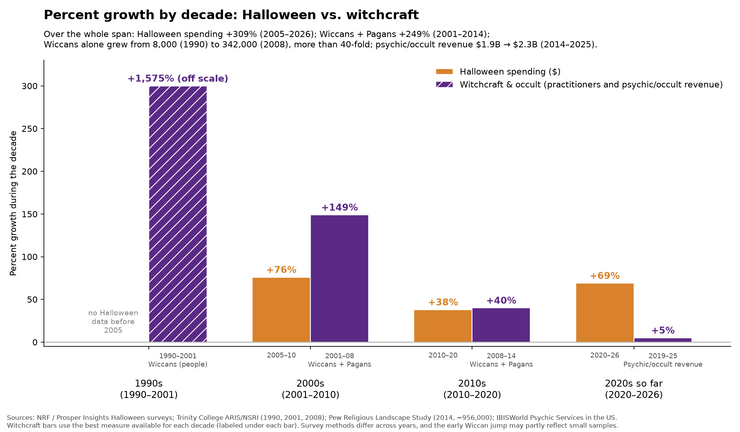
Halloween is no longer a small night of costumes for children. In 2005 Americans planned to spend $3.3 billion on it. In 2026 they plan to spend $13.5 billion, more than four times as much. About 74% of Americans now celebrate, up from 53% in 2005, and adults spend more on their own costumes ($2 billion) than on their children's ($1.5 billion). The most popular adult costume this year is the witch. The charts that follow trace that growth beside the growth of real witchcraft and the occult in America.
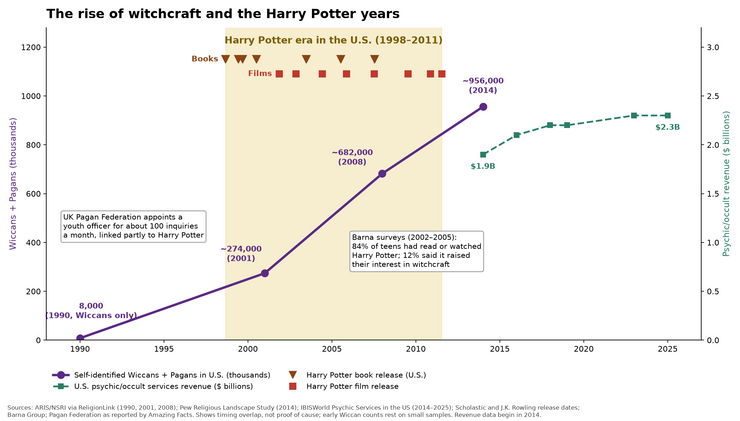
Over the same years, the number of Americans who call themselves Wiccans or Pagans grew from about 8,000 in 1990 to nearly a million by 2014. Americans now spend about $2.3 billion a year on psychics, tarot readers, and fortune tellers, and three in ten adults consult astrology, tarot, or a fortune teller at least once a year. The steepest rise came between 1998 and 2011, the years the Harry Potter books and films taught a generation of children to see witchcraft as harmless and heroic. Charts do not prove that one thing caused another, but they do show what the culture has been sowing and reaping. God's Word is plain: "There shall not be found among you any one that... useth divination, or an observer of times, or an enchanter, or a witch" (Deuteronomy 18:10).

CHILDREN OF THE LIGHT
The world may walk in shadows deep,
Where masks of fear their vigil keep;
With phantom shapes and ghostly cries,
They echo Satan’s ancient lies.
They claim the dead return to roam,
To haunt the street and seek the home;
Yet God has spoken plain and clear:
No wandering spirit lingers here.
In silent dust the weary rest,
No thoughts disturb the quiet breast;
They know not anything at all,
Until the Life-giver shall call.
Why should we touch the dark display,
Or borrow rites from Druid day?
Why drape ourselves in dread and night,
When Jesus made us sons of light?
No festive compromise we claim,
No pagan feast in Christian name;
We leave the revelers outside,
And in the Savior’s peace abide.
Within our home the lamps are lit,
Where around the Holy Word we sit;
We shun the paths of fear and sin,
And let the heavenly glory in.

OCTOBER 31, 1517
THE NIGHT A MONK DEFIED ROME
While the world spends October 31 on costumes and candy, another event took place on that same date that is far more worthy of remembrance. On October 31, 1517, the eve of the All Saints' festival, an Augustinian monk named Martin Luther posted ninety-five propositions against the sale of indulgences on the church door at Wittenberg,
Germany. For nearly a thousand years, ever since papal supremacy was established in A.D. 538, the Church of Rome had ruled over the kings and consciences of Christendom. She kept the Bible from the common people and claimed the power to forgive sins for a price. To raise money for St. Peter's in Rome, indulgences were sold across Germany by the friar Tetzel. Ellen White describes the scene: "The Roman Church had made merchandise of the grace of God. The tables of the money-changers were set up beside her altars, and the air resounded with the shouts of buyers and sellers." Tetzel assured the people "that the very moment the money should clink against the bottom of his chest, the soul in whose behalf it had been paid would escape from purgatory and make its way to Heaven."
Nowhere in Scripture is such a traffic found. When Simon Magus tried to buy the gift of God, Peter answered, "Thy money perish with thee, because thou hast thought that the gift of God may be purchased with money" (Acts 8:20). Luther, who had found peace not in penance but in Christ, could keep silent no longer. "On the day preceding the festival, Luther went boldly to the church, to which crowds of worshipers were already repairing, and affixed to the door ninety-five propositions against the doctrine of indulgences. These theses he declared himself ready to defend against all opposers." By them "it was shown that the power to grant the pardon of sin, and to remit its penalty, had never been committed to the pope or to any other man. The whole scheme was a farce,—an artifice to extort money by playing upon the superstitions of the people,—a device of Satan to destroy the souls of all who should trust to its lying pretensions."
One man now stood against the mightiest power on earth. "Who was I," Luther wrote, "to oppose the majesty of the pope, before whom the kings of the earth and the whole world trembled?" Yet God carried his words farther than he could have imagined: "The questions which he proposed had in a few days spread through all Germany, and in a few weeks they had sounded throughout Christendom" His strength was the Word alone. "When enemies appealed to custom and tradition, or to the assertions and authority of the pope, Luther met them with the Bible and the Bible alone" He "firmly declared that Christians should receive no other doctrines than those which rest on the authority of the Sacred Scriptures. These words struck at the very foundation of papal supremacy. They contained the vital principle of the Reformation."
That is why October 31 deserves to be remembered, not as a night given to frolicking amongst those who do not follow God, a night that stems from dead occult practices lifting up the work of devils, but instead, look at October 31 as a day to worship God and possibly remember how God brought light back into the world during the dark ages.
"At Wittemberg a light was kindled whose rays should extend to the uttermost parts of the earth, and which was to increase in brightness to the close of time" We are heirs of that light, and the battle is not over. "There was a present truth,—a truth at that time of special importance,—in the days of Luther; there is a present truth for the church today. But truth is no more desired by the majority today than it was by the papists who opposed Luther". This October 31, let us turn off the porch light to Halloween and open the Bible, as Luther did, standing on the Word of God alone.
Source: Ellen G. White, The Spirit of Prophecy, vol. 4 (1884), chapter 6, "Luther's Separation from Rome," pp. 94–118. Read online: https://m.egwwritings.org/en/book/140.349
From the Pen of Inspiration
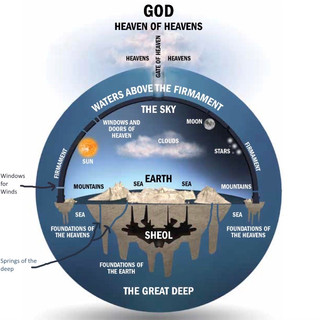
A FIRMAMENT OF CHOSEN ONES
"Among earth’s inhabitants, scattered in every land, there are those who have not bowed the knee to Baal. Like the stars of heaven, which appear only at night, these faithful ones will shine forth when darkness covers the earth and gross darkness the people. In heathen Africa, in the Catholic lands of Europe and of South America, in China, in India, in the islands of the sea, and in all the dark corners of the earth, God has in reserve a firmament of chosen ones that will yet shine forth amidst the darkness, revealing clearly to an apostate world the transforming power of obedience to His law. Even now they are appearing in every nation, among every tongue and people; and in the hour of deepest apostasy, when Satan’s supreme effort is made to cause “all, both small and great, rich and poor, free and bond,” to receive, under penalty of death, the sign of allegiance to a false rest day, these faithful ones, “blameless and harmless, the sons of God, without rebuke,” will “shine as lights in the world.” Revelation 13:16; Philippians 2:15.
The darker the night, the more brilliantly will they shine. — Prophets and Kings, pp. 188–189
YouTube

Comments